
Besakih Great Temple
Complete Besakih Temple Information Guide
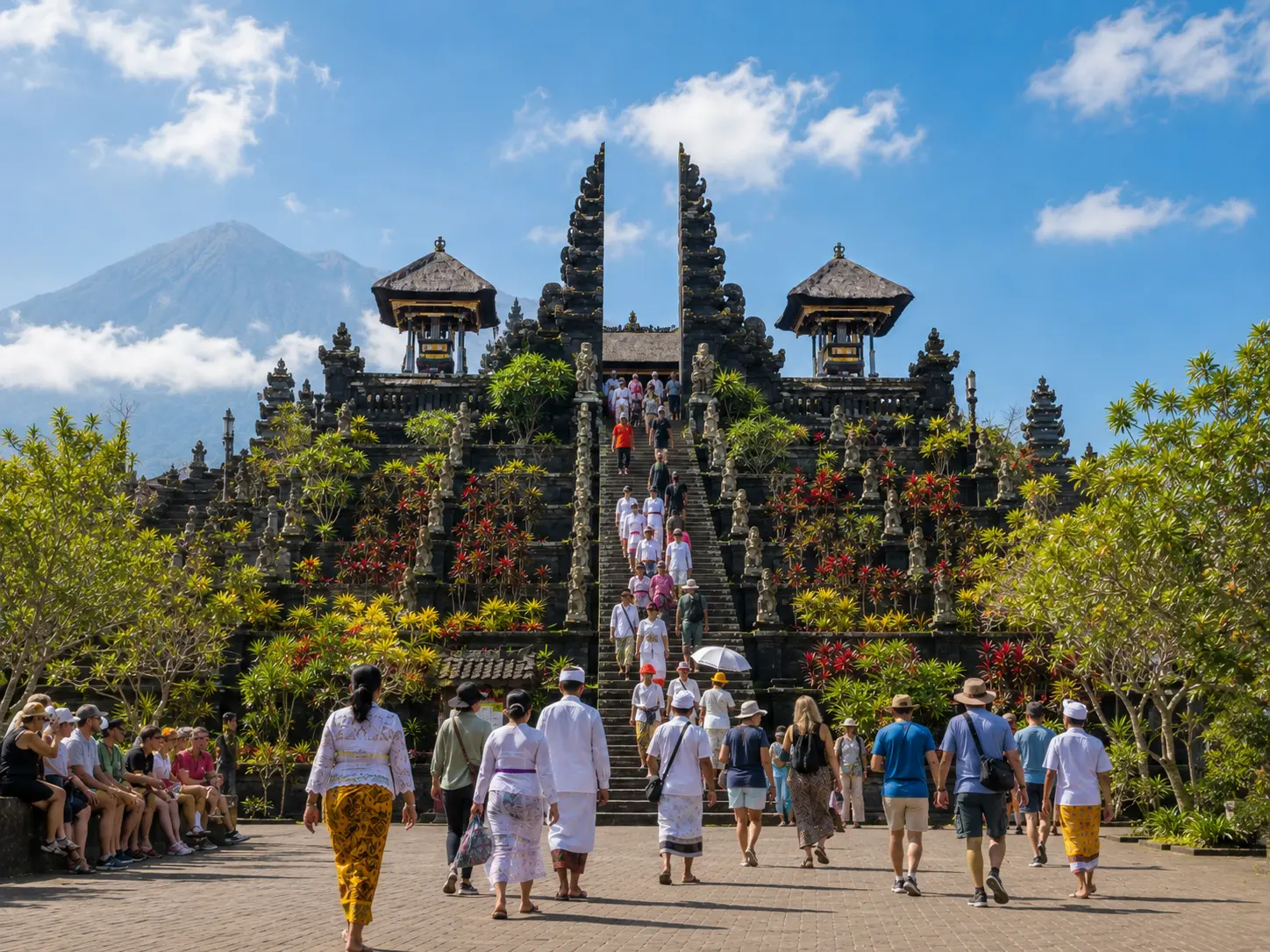
Besakih, Bali’s Mother Temple, is a living Hindu temple complex on the slopes of Mount Agung in Karangasem. Visit for its religious significance, temple architecture and mountain setting—not simply a photograph at the entrance.
BESAKIH GREAT TEMPLE
Explore This Guide
Choose a topic to jump to the information you need.
BESAKIH GREAT TEMPLE
Booking Options
Start with personal local help, or compare online platforms.
Online bookings are handled by the selected platform. Personal assistance is provided separately by Best Bali Adventures.
What to Know Before Visiting Besakih
Plan a cultural visit with time to walk, listen and observe. Choose a manageable route rather than trying to reach every shrine. Agree on your return transport before arriving, and keep the schedule flexible enough to follow the temple’s arrangements on the day.
Besakih Temple Quick Facts
| Practical detail | What to expect |
|---|---|
| Location | Besakih, Rendang district, Karangasem, on the slopes of Mount Agung. |
| Main focus | Pura Penataran Agung and the surrounding temple complex. |
| Suggested time on site | Around 1.5–2 hours for a standard visit; add time for arrival, breaks and a longer route. |
| Adult admission budget | Approximately IDR 150,000 for international visitors; IDR 80,000 for domestic visitors. Confirm current categories and prices. |
| Included visitor services | Local guide, sarong hire and one electric-shuttle transfer, according to temple management. |
| Tourist visiting hours | Daytime. Published hours vary; confirm the opening time and final admission for your date. |
| Walking | Slopes, stone paths and stairs; the shuttle does not make the entire complex step-free. |
| Main limitation | Visitor access does not mean unrestricted entry to every sacred courtyard. |
Is Besakih Temple Worth Visiting?
Yes, when Balinese religion and temple architecture matter to you enough to justify the journey. It is a less suitable choice for a rushed stop between distant attractions.
The experience makes more sense when you ask what the different shrines mean and how worship shapes the complex. Do not judge the visit solely by whether Mount Agung is visible or whether a particular gate is open.
| Your priority | A sensible decision |
|---|---|
| Culture and architecture | Make Besakih the main visit of the morning, rather than one stop on an overloaded itinerary. |
| A short outing from your hotel | Compare the full round-trip journey with a closer cultural attraction before deciding. |
| A relaxed family day | Choose a shorter walking route and one additional stop at most. |
| A particular photograph | Treat the photograph as a bonus, not a promise of unrestricted access or clear mountain views. |
Understanding the Besakih Temple Complex
Besakih is a group of temples, not one building with a single interior. Pura Penataran Agung is its central religious focus. The management’s description of the sacred area lists this central temple together with 25 surrounding temples.
The name “Mother Temple” expresses Besakih’s importance within Balinese Hindu religious life. For visitors, that means the site should be approached as a place of worship rather than a museum whose every space is available to explore.
Main Temples Within Besakih
Pura Penataran Agung
Begin with the central temple. Its important Padma Tiga shrine is associated with three aspects of Shiva in the temple’s own explanation. Ask your guide to explain the symbolism from an area where visitors are permitted; seeing a shrine does not automatically mean being allowed to approach it.
Pura Batu Madeg
Batu Madeg lies north of Penataran Agung and is associated with Vishnu. Its main eleven-tiered meru is one of the distinctive shrines within the wider complex.
Pura Kiduling Kreteg
Kiduling Kreteg is associated with Brahma and the southern direction. Together, these temples help explain Besakih as a connected sacred landscape. Do not assume a standard visit includes entry to each of them.
Entrance Fees & What You Pay For
Budget around IDR 150,000 per international adult and IDR 80,000 per domestic adult for standard admission. These are published visitor rates, not a guarantee of the price or eligibility category on your travel date.
Confirm children’s prices and age cut-offs at the official counter or with your booking provider. Published guides disagree on child-ticket arrangements; an adult price should not be used to calculate a family total without checking.
Keep a separate allowance for parking, refreshments and any return-shuttle charge. A quoted private-car or day-tour price may cover transport only, so check whether admission is included before comparing offers.
Arrival, Sarongs & the Included Guide
The official visitor arrangements include a local guide, sarong hire and one electric-shuttle transfer. Management states that visitors are accompanied by a local guide within the sacred area.
- Use the designated arrival area. Check the official counter or your voucher’s redemption instructions before paying anyone else.
- Keep proof of admission. Confirm where to collect the sarong, meet the guide and board the shuttle.
- Agree on the walking route. Mention children, limited stamina or mobility needs before starting.
- Clarify the return. One included transfer does not mean that both directions are included.
Before paying for an additional guide, garment or service, ask counter staff what your admission already covers. Ask for a clear explanation of any extra charge; do not confuse a proposed tip or optional service with the published ticket inclusions.
Should You Book a Ticket, Tour or Driver?
Separate admission from the transport and itinerary you need. Arriving independently does not remove the temple’s local-guide arrangements.
| Option | What to check |
|---|---|
| Admission on arrival | Current price, visitor category, included services and the permitted route. |
| Private car and driver | Total vehicle price, hours, pickup area, parking, waiting time and whether temple admission is extra. |
| Organised temple or day tour | Exact stops, time at Besakih, admission, guide arrangements, hotel transfer and cancellation terms. |
Reserve transport in advance when you need a particular departure time, child seat, larger vehicle or a carefully planned combination of stops. Before paying for an online product described as a “ticket”, read whether it is admission alone or a package with pickup and other services.
Use the Besakih Temple booking page to compare the available booking routes and local planning assistance.
Planning Your Visit
Allow roughly two hours at Besakih and plan to arrive in the morning. This is a planning allowance, not a fixed tour duration.
Opening Hours & Arrival Time
Visitor guides commonly list daytime access around 07:00–18:00, but some publish narrower hours. Confirm the current opening time and last admission rather than arriving at the earliest or latest time shown online. Religious access and programme schedules are not the same as ordinary tourist admission.
A practical target is arrival around 08:00–10:00. Leave additional time for ticketing, the transfer and meeting your guide. Avoid making the final afternoon admission your only chance to visit.
Weather & Visibility
The elevated setting can bring rain, cloud and wet steps. A temple visit can still be worthwhile without a clear mountain view. Carry rain protection and postpone exposed walking when conditions are uncomfortable or unsafe.
Do not promise yourself both an empty complex and a major ceremony. Choose a quieter visit for easier movement, or accept more waiting and access changes when observing religious activity is important to you.
Getting to Besakih Temple
Plan the complete return journey, not just the outbound ride. Besakih is inland in Karangasem rather than beside Bali’s main southern resort areas.
From Ubud, allow approximately 1.5–2 hours in ordinary traffic as an initial planning estimate. The exact hotel location, road conditions and stops can make the journey longer. For Sanur, Canggu, Seminyak, Nusa Dua or Uluwatu, get a current route estimate from your actual accommodation instead of using one universal “South Bali” travel time.
For a private driver and return transport to Besakih, visit BestBaliDrivers.com. Confirm your pickup location, waiting time, return journey and total vehicle price before booking. Agree on a meeting point with the driver rather than relying on finding an unplanned return ride after the visit.
For navigation, use the managed visitor arrival and parking area for Besakih Great Temple. A pin for an individual shrine may not be the correct public drop-off point.
What Can You Combine With Besakih?
Choose one additional area that fits the direction of your journey. A shorter itinerary gives you more control over traffic, walking and lunch.
| Possible addition | How to approach it |
|---|---|
| Penglipuran Village | A cultural pairing with Besakih. Check the road route and give each visit enough time rather than adding several more attractions. |
| Sidemen | Consider a relaxed meal or countryside stop when the route works from your accommodation. |
| A waterfall or viewpoint | Choose one specifically, checking the extra driving and walking. “Nearby” in a tour description does not mean a quick roadside stop. |
Do not combine every East Bali highlight simply because they appear on the same map. Ask the driver for the total estimated driving time and decide what to remove before the day begins.
Dress Code & Respectful Behaviour
Dress for a working temple and follow the local guide’s instructions about access. Wearing the correct clothing is not permission to enter every courtyard.
What to Wear
Wear a modest top covering the shoulders and chest, and use the sarong and sash as instructed at the entrance. Choose secure footwear suitable for steps. There is no reason to buy a garment before checking the rental arrangements included with admission.
Inside the Sacred Area
- Keep prayer routes clear. Wait when a procession or group of worshippers needs to pass.
- Respect boundaries. Do not enter a closed courtyard, climb a shrine or cross a barrier for a photograph.
- Ask before close-up photography. Give worshippers space and avoid interrupting rituals.
- Leave offerings undisturbed. Watch where you step and keep children close.
The temple’s published rules do not permit entry to the inner sacred area during menstruation. Follow management’s guidance about which areas may be visited.
Do not assume drone use is permitted. Ask management about permission before bringing a drone into use around the temple.
Children, Stairs & Accessibility
Families can visit, but this is a walking visit rather than a fully step-free attraction. Expect slopes, stairs and uneven or wet stone surfaces.
For younger children, choose a manageable route, pause for water and explain in advance that quiet behaviour is expected. A baby carrier may be more practical than relying on a stroller across the whole route, provided the adult is comfortable carrying the child on steps.
For wheelchair users or anyone who finds stairs difficult, request specific access information before travelling: the drop-off point, transfers, step-free viewing areas, toilet access and the route back to the vehicle. The presence of a shuttle should not be treated as confirmation that the temple itself is wheelchair accessible.
Tell the guide how much walking is comfortable. Seeing less at an appropriate pace is better than committing to a route that becomes difficult to finish.
Facilities & What to Bring
Use the arrival facilities before beginning the walking route. Temple management lists organised parking, electric-vehicle transfers and toilets, with food options around the wider visitor area.
Bring drinking water, a light rain layer, secure footwear and enough rupiah for smaller expenses. Keep your admission receipt and booking confirmation available. A small bag is easier to manage on steps than carrying loose belongings.
Ask about the nearest toilet and the return pickup point while you are still at the entrance. Visitors with particular food, accessibility or payment needs should confirm these individually rather than relying on a general facilities list.
Frequently Asked Questions
Are Besakih Temple and Besakih Great Temple the Same Place?
Yes. Besakih Temple, Besakih Great Temple, Pura Agung Besakih and Bali’s Mother Temple are names used for this complex. Pura Penataran Agung is the central temple within it, not a separate destination requiring another journey.
Do All the Temples Celebrate on the Same Date?
No. Different temples have their own observances. Penataran Agung, Batu Madeg and Kiduling Kreteg have separate ceremonial calendars in the management’s descriptions. Confirm the date and visitor arrangements for the particular ceremony that interests you.
Is a Purification Ceremony Included in Admission?
Do not assume so. The management advertises separate spiritual programmes, including melukat, with their own advance arrangements. Ask specifically about the ceremony, location, eligibility, clothing, offerings and complete cost rather than treating ordinary sightseeing admission as a ritual booking.
Does the Visit Include Climbing Mount Agung?
No. Visiting the temple does not mean booking a mountain ascent. Do not add a summit climb to an ordinary temple itinerary without separately checking the route, conditions, permissions and appropriate guiding arrangements.
Related Experiences
These cultural guides help you compare different kinds of experience. They are not a suggestion to fit all three into the same day.
A useful cultural comparison when you are interested in traditional village layout and everyday customs, rather than another temple complex.
Explore Balinese storytelling through performance. Choose the venue and show time separately from your Besakih visit.
Read about melukat when you want to understand a participatory ritual rather than a sightseeing visit.
Final Advice
Make Besakih the main cultural stop of the morning, allow around two hours and keep the rest of the day simple. Confirm admission and return transport, understand what the included guide and shuttle cover, and choose a walking route that suits your group.
Go for the meaning of the place, not a guaranteed photograph. Respectful access and a realistic schedule matter more than visiting the greatest number of shrines.
Explore the Best Bali 4 U Network
Continue with these connected resources when you need broader Bali information or help planning the rest of your visit.
Booking & Local Assistance
For current Besakih Temple ticket and tour options, use the dedicated booking page on BestBaliActivities.com, or contact Best Bali Adventures for personalised local help with your visit and transport.
Questions About This Guide?
Have you noticed information that needs correcting or updating? Contact the editorial team with questions about this guide, reliable local knowledge or suggestions that could help other visitors.